
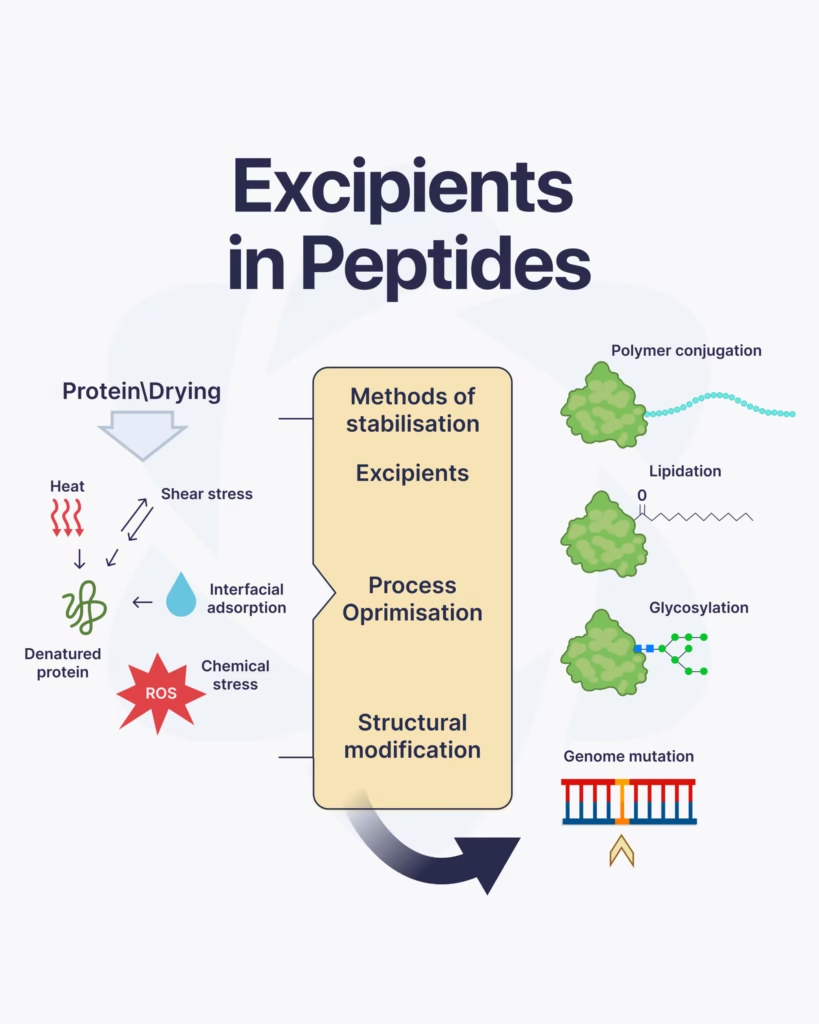
What Are Excipients?
Excipients are inactive substances added to a formulation alongside the primary compound. In peptide research, excipients serve important roles in stabilizing, protecting, or delivering the peptide in a controlled way. While they do not provide direct biological activity, they ensure that peptides remain intact and usable during storage, handling, and experimental application.
(Reference: Rowe et al., 2006)
Why Are Excipients Important for Peptides?
Peptides are highly sensitive molecules that can degrade due to light, heat, moisture, or enzymatic activity. Excipients are added to mitigate these challenges. They can:
-
Prevent peptide aggregation or oxidation.
-
Adjust pH for stability.
-
Enhance solubility for laboratory use.
-
Serve as bulking agents during lyophilization (freeze-drying).
Common Excipients in Peptide Formulations
Researchers often use a small set of excipients with well-documented properties:
-
Mannitol and trehalose – Act as cryoprotectants and stabilizers during freeze-drying.
-
Arginine or glycine – Improve solubility and reduce aggregation.
-
Buffers (e.g., phosphate, citrate) – Maintain pH and ionic strength.
-
Polysorbates (e.g., Tween 20, Tween 80) – Protect against surface adsorption and aggregation.
Research Applications
Excipients are not studied for therapeutic effects themselves but are critical in laboratory preparation. They are used to maintain peptide integrity in storage vials, support reproducibility in cell culture assays, and provide consistent results across repeated experiments. Their inclusion helps ensure that observed outcomes are due to the peptide under study, not instability of the sample.
(Reference: Carpenter et al., 2002)
References
All products sold by Direct Peptides are strictly for laboratory research purposes only. They are not intended for human or animal consumption, medical, or therapeutic use. The information provided on this website is for educational and informational purposes only.
