
What Is Lyophilization?
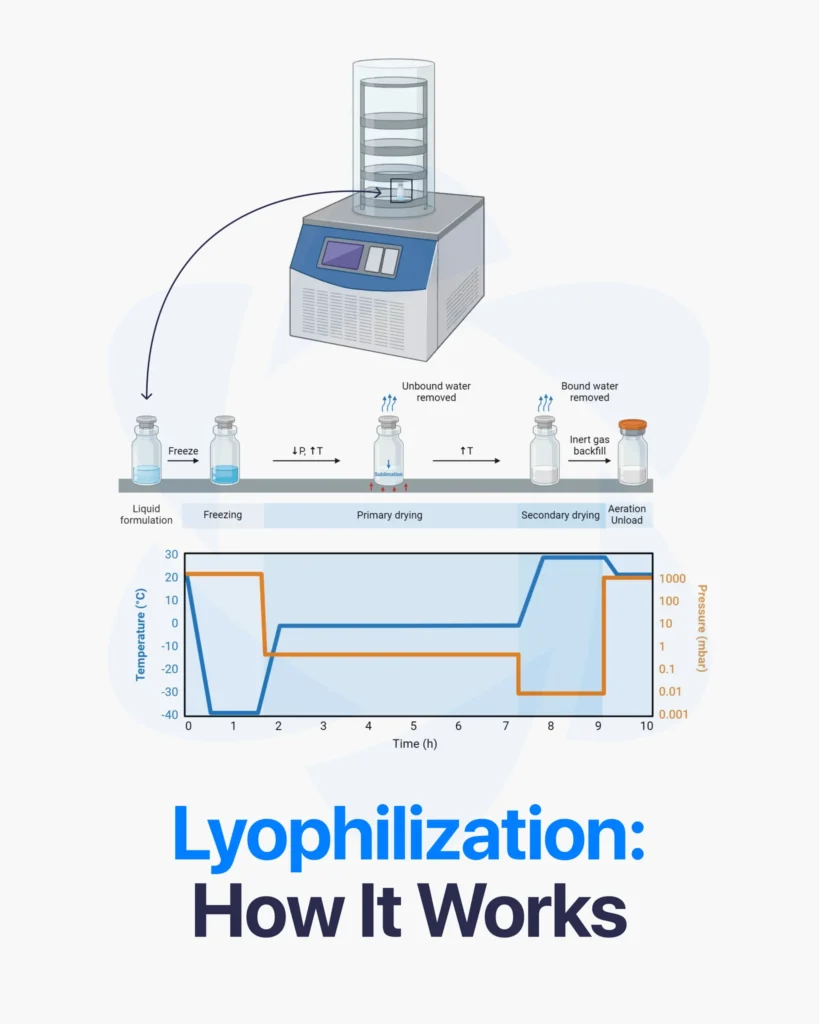
Lyophilization, also known as freeze-drying, is a dehydration process commonly used in research and pharmaceutical labs to preserve biological materials. The technique removes water from a frozen sample through sublimation — the direct transition of ice into vapor — under reduced pressure. This helps maintain the structure and stability of sensitive compounds such as peptides, proteins, and vaccines.
(Reference: Tang & Pikal, 2004)
How Does the Process Work?
Lyophilization typically occurs in three stages:
-
Freezing – The sample is cooled until water turns to ice, creating a solid matrix that stabilizes the material.
-
Primary Drying (Sublimation) – Pressure is lowered, and heat is gently applied, causing frozen water to sublimate into vapor without passing through the liquid phase.
-
Secondary Drying (Desorption) – Remaining bound water molecules are removed, reducing final moisture content to very low levels.
Why Do Researchers Use Lyophilization?
The method is widely used because it allows long-term preservation of compounds that are unstable in liquid form. For peptides and proteins, lyophilization minimizes degradation, supports easier storage and transport, and enables precise reconstitution for experiments. The process is also scalable, from small laboratory samples to large industrial batches.
Key Applications in Laboratory Research
-
Preserving peptide and protein samples for extended shelf life.
-
Stabilizing vaccines and biologics during production and distribution.
-
Preparing reference standards for analytical methods such as HPLC.
-
Enabling controlled reconstitution for in vitro or in vivo research models.
(Reference: Tang & Pikal, 2004)
References
All products sold by Direct Peptides are strictly for laboratory research purposes only. They are not intended for human or animal consumption, medical, or therapeutic use. The information provided on this website is for educational and informational purposes only.
