
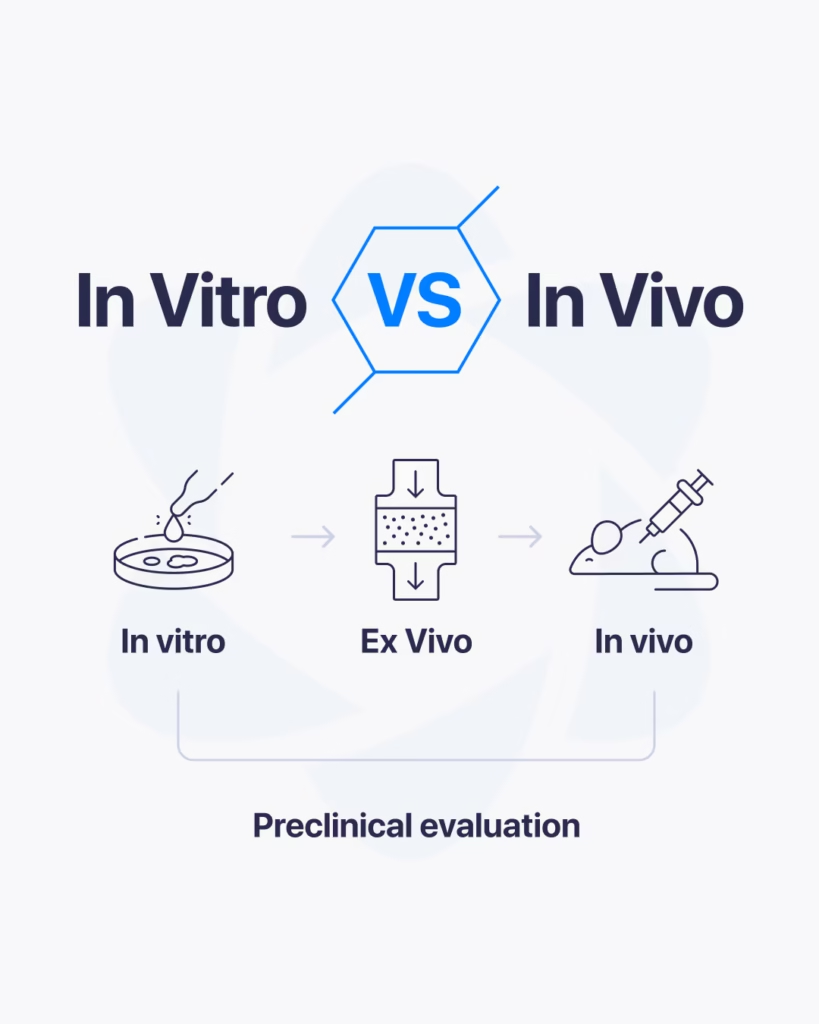
What Are In Vitro Studies?
In vitro studies are experiments done outside of living organisms — usually in test tubes, petri dishes, or lab equipment. The term “in vitro” means “in glass” in Latin. Researchers use these studies to learn how peptides and other compounds behave at a cellular or molecular level before moving on to animal or human trials.
This kind of research helps scientists understand how a peptide might affect things like protein signaling, tissue regeneration, or inflammation — without needing a full living system.
(Reference: Pampaloni et al., 2007)
How Are In Vitro Studies Used in Peptide Research?
Peptides like BPC-157, GHK-Cu, and Semaglutide are often studied in vitro before any in vivo (in-animal or human) work is considered. These lab studies can help test:
• Cell growth and recovery
• Collagen production
• Wound repair mechanisms
• Antioxidant activity
• Inflammatory responses
Advantages of In Vitro Testing
-
Controlled Environment
In vitro setups allow researchers to isolate one variable at a time. This means they can precisely measure how a peptide influences a single pathway — like nitric oxide production or growth factor expression.
-
Early Safety Insights
By observing peptide effects on cultured cells, scientists can gather preliminary safety data and decide if further testing is warranted.
-
Cost-Effective and Scalable
Compared to live animal studies, in vitro tests are faster and less expensive — ideal for early-stage research.
Limitations to Be Aware Of
In vitro studies don’t replicate the complexity of a full biological system. Just because a peptide activates a response in a petri dish doesn’t guarantee the same effect in a human or animal model. That’s why in vitro studies are only one step in the broader research process.
(Reference: van der Worp et al., 2010)
Common Peptide In Vitro Applications
• Testing cellular repair with BPC-157
• Studying copper-binding and collagen synthesis using GHK-Cu
• Analyzing receptor activity with GLP-1 analogs like Semaglutide or Tirzepatide
References
All products sold by Direct Peptides are strictly for laboratory research purposes only. They are not intended for human or animal consumption, medical, or therapeutic use. The information provided on this website is for educational and informational purposes only.