
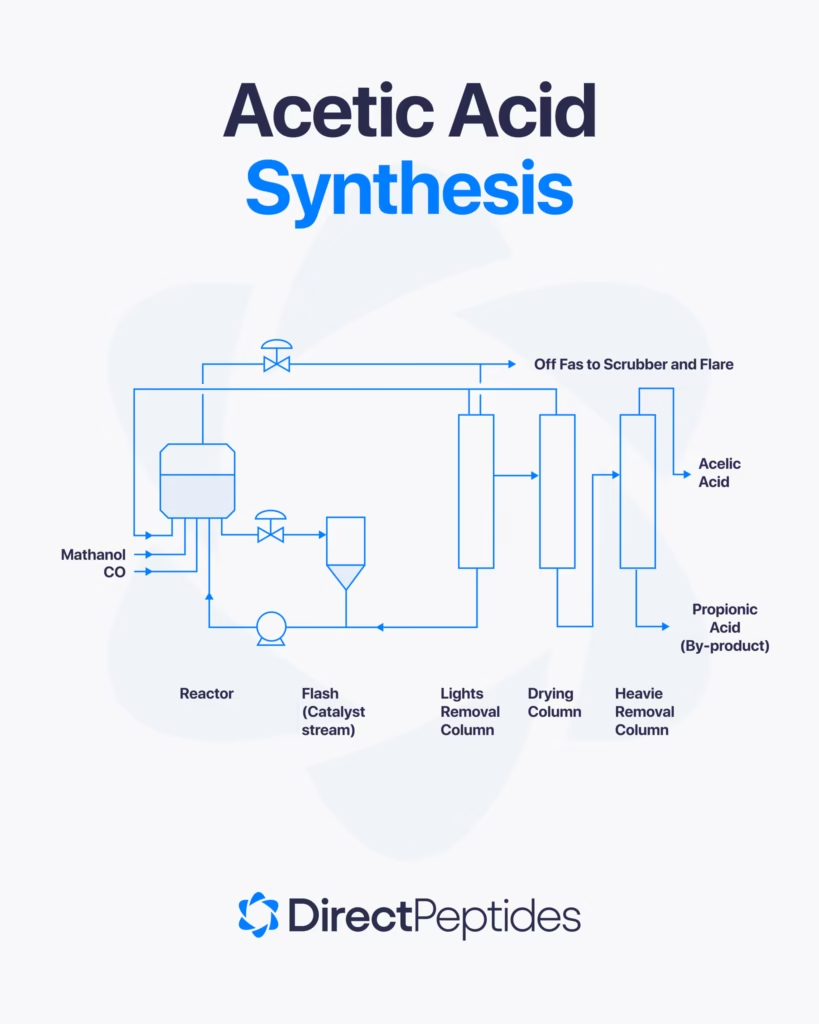
Why Revisit Acetic Acid Synthesis Today?
Acetic acid is a foundational industrial chemical, used in polymers, solvents, and chemical intermediates. Traditional production (e.g. methanol carbonylation) continues to dominate, yet concerns about carbon footprint, energy efficiency, and sustainability have driven new innovation efforts. In 2025, several studies and technologies are emerging that aim to transform how acetic acid is made at scale.
(Reference: Medrano-García et al., 2025)
What Are the Recent Innovations?
Recent research focuses on more sustainable, lower-energy, or carbon-utilizing methods. Key trends include:
-
Green Catalytic Routes: Efforts to tweak or reinvent the classic carbonylation methods (e.g. Cativa/Monsanto variants) to reduce waste and energy consumption. For instance, new simulation-based designs reduce distillation steps and recover reactor heat more efficiently. (Reference: “Optimization of Acetic Acid Production” paper, 2025)
-
Carbon Capture & Utilization (CCU): Partnerships combining industrial CO₂ emissions and microbial or catalytic conversion into acetic acid, effectively turning waste carbon into a useful feedstock. (Reference: Key Developments in Acetic Acid Industry, 2025)
-
Photocatalytic CO₂ Reduction: New photocatalyst systems (e.g. chiral mesostructured ZnIn₂S₄) demonstrate exceptionally high selectivity toward acetic acid from CO₂ under light. These systems may signal a shift toward light-driven, low-temperature acetic acid generation. (Reference: Cui et al., 2025 preprint)
-
Process Intensification & Purity Gains: Researchers are applying process intensification (reducing steps, combining functions) and purity optimization in methanol carbonylation systems. These approaches limit energy usage and reduce separation burdens. (Reference: Optimization of Acetic Acid Production paper, 2025)
What Recent Studies Reported
Recent literature offers several interesting observations from lab and simulation studies:
-
In the “Win–Win More Sustainable Routes” paper, researchers showed that alternative pathways (e.g. integrating biomass or waste feedstocks) can reach yields competitive with conventional methods if catalyst selectivity is high and separation steps are minimized. (Reference: Medrano-García et al., 2025)
-
The process optimization study using the Cativa framework demonstrated that by reducing the number of distillation steps from three to two and coupling reactor heat to drive separations, the total energy consumption could drop significantly. (Reference: Optimization paper, 2025)
-
The ZnIn₂S₄ photocatalyst system achieved a reported acetic acid formation rate of ~962 μmol·g⁻¹·h⁻¹ with ~97.3% selectivity under lab conditions, which is significantly higher than many prior systems. This suggests improved catalyst design and charge transfer path control may unlock scalable photochemical approaches. (Reference: Cui et al., 2025 preprint)
-
Industry trend analyses indicate that major chemical companies are investing more in CCU-based acetic acid and green pathways to comply with emissions policies. For example, BP and LanzaTech’s collaboration aims to convert CO₂ emissions into acetic acid feedstock using advanced carbon capture technologies. (Reference: Coherent Market Insights, 2025)
How These Innovations May Be Used in Research & Industry
-
Benchmarking New Catalysts: Researchers can compare novel catalysts (e.g. chiral sulfide systems, dual-site catalysts) against conventional Cativa benchmark to assess tradeoffs in selectivity, stability, and energy cost.
-
Hybrid Systems: Integrating CCU or photocatalysis with carbonylation (e.g. partial photogenerated acetic acid feeding into conventional units) may offer transitional deployment paths.
-
Process Design Studies: Energy integration, heat recovery, and simplified separation schemes from recent papers provide case studies for designing pilot plants.
-
Life-Cycle & Carbon Accounting: The new routes allow researchers to explore production pathways with lower GHG footprints; lifecycle assessments are vital to decide which innovations are truly greener.
References
All products sold by Direct Peptides are strictly for laboratory research purposes only. They are not intended for human or animal consumption, medical, or therapeutic use. The information provided in this blog post is for educational and informational purposes only.